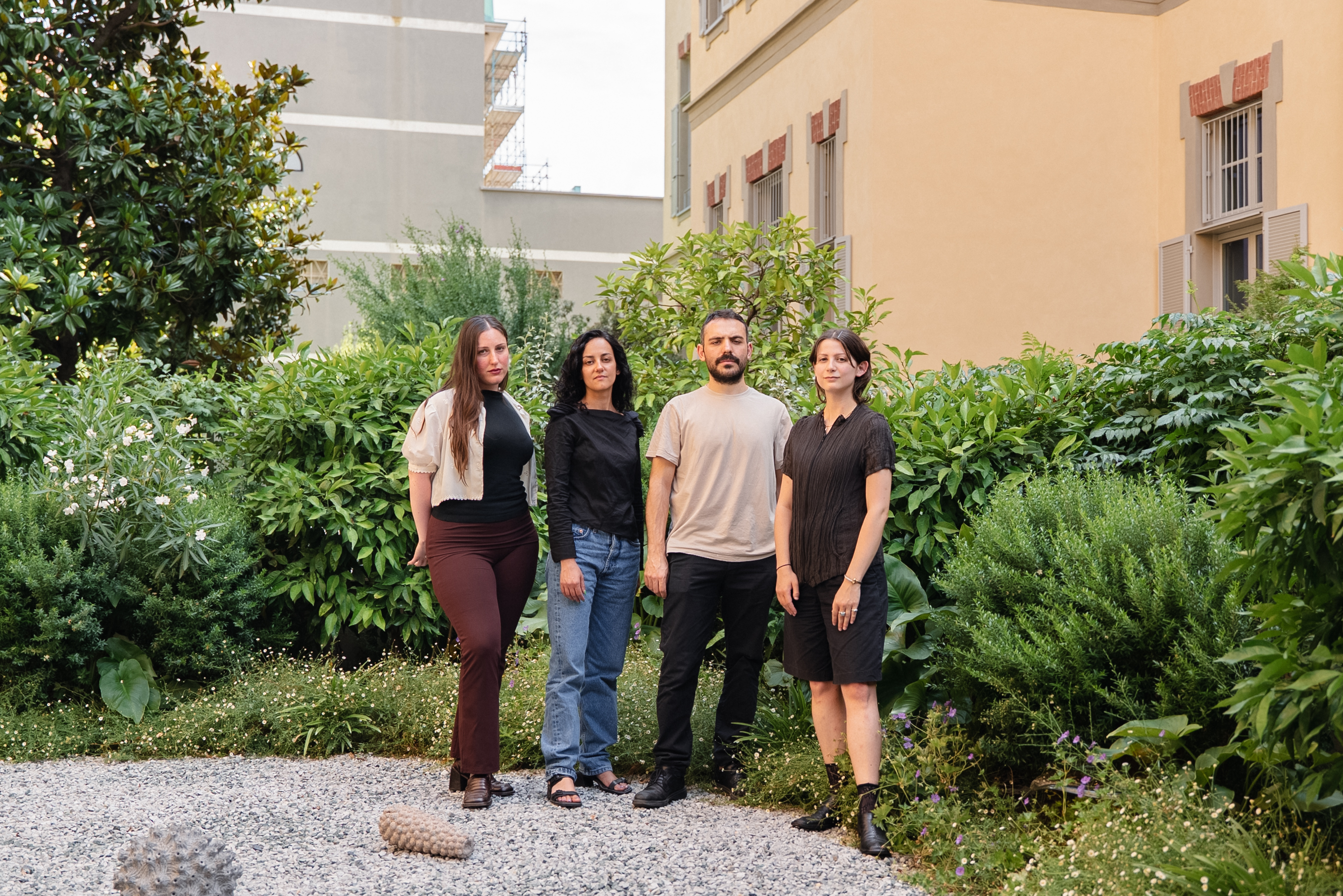
Ornella Cardillo, Giuseppe Lo Cascio, Natalya Marconini Falconer, Stella Rochetich
01.05.2025 – 31.07.2025What does it mean to inhabit a place? What are the characteristics that set it apart from others?
For the past five years, the Elpis Foundation has been asking these questions—not so much to find definitive answers, but to understand what happens the very moment we ask them and to engage with the reasoning that emerges from them. It does so by intertwining contemporary art and the local landscape: first in small towns with Una Boccata d’Arte and now, in the city of Milan, with Atelier Elpis, a residency project that invites young artists to engage with the city as a space lived in, observed, and questioned.
Living, in fact, is not merely occupying a space but sharing memories and actively participating in the life of the community. Cities, like small towns, are networks of memory, languages, and presences. In this sense, Atelier Elpis emerges as a natural continuation of the work initiated in inland and peripheral areas across Italy, now bringing that approach rooted in the urban complexity of Milan. It is interesting—and in part paradoxical—to find in a metropolis some of the same themes and tensions that emerged in the villages: depopulation, gentrification, touristification, and the loss of local identity. The city appears as an organism in transformation, often driven by profit rather than life. So what remains, today, of Milan beneath its invention—that is, beneath the narrative veneer that has for years marked its growth and metamorphosis?
During the residency period, through collaborations with local artisans, associations, and personal research, each of the four artists focused on a specific element that became the symbol and generative principle of an entire urban narrative. Together, the four narratives unfold across the spaces of Fondazione Elpis as a single score of urban visions.
Natalya Marconini Falconer reads the city as a constellation of traces, where industrial memory intertwines with family memory, following a thread that connects the produce market, the production of Pirelli copper cables, and the working-class history linked to migration from Southern Italy. Ornella Cardillo, on the other hand, constructs a network of scenic machines and theaters of time that emerge from listening to the city as a living organism. Giuseppe Lo Cascio intervenes on the language of objects, displacing them and rendering them dysfunctional, to convey the attractive and repulsive tensions that traverse urban space. In the end, Stella Rochetich’s Milan is a place made of bodies: human organisms that leave traces of their passage—chemical marks, odors, skin residues. Silent testimonies that tell intimate stories and remind us that inhabiting also means touching and contaminating.