YOU ARE HERE. Central Asia
curated by Dilda Ramazan e Aida Sulova
Lavanderia
Via Lamarmora 26, Milan
Aika Akhmetova, Medina Bazargali, Temur Shardemetov, Gulnur Mukazhanova, Qizlar, Nurbol Nurakhmet, Aïda Adilbek, Marat Raiymkulov, Kasiet Jolchu, Sonata Raiymkulova, Saodat Ismailova, Chyngyz Aidarov, Azadbek Bekchanov, Munara Abdukakharova, Emil Tilekov, Yerbossyn Meldibekov, Vyacheslav Akhunov, Ester Sheynfeld, Alexey Rumyantsev, Anna Ivanova, Bakhyt Bubikanova, Ulan Djaparov, Zhanel Shakhan, Said Atabekov, Rashid Nurekeyev, Daria Kim, Jazgul Madazimova
YOU ARE HERE. Central Asia presents a vibrant array of artistic visions from Central Asia, curated by two Central Asian curators.
Through media such as painting, video, sculpture, photography, textiles, site-specific installations, and performance, the exhibition presents the works and artistic research of 27 contemporary artists born in Kazakhstan, Kyrgyzstan, Tajikistan, and Uzbekistan.
The title and thematic framework of the exhibition draw their origin from the everyday phrase of the same name used to orient oneself in various places, streets, cities, or countries, often accompanied by a graphic pointer indicating the exact location and allowing one to situate oneself in physical space. Metaphorically, the exhibition YOU ARE HERE. Central Asia expresses a sense of self-awareness and a recognition of one’s presence across different planes of existence.
In today’s world, characterized by constant migration, displacement, and the search for a place to call home, the concepts of identity and belonging are of great importance, as they ensure one’s visibility and the right to find one’s place.
The artists were encouraged to move beyond the literal map and, avoiding exploitation and exoticizing attitudes, to mark their presence in ways that resonated with their self-perception, their perspectives, memories, feelings, and lived experiences. Whether mental, physical, spiritual, geographical, metaphysical, or political, all perspectives were welcomed in the conception of the exhibition.
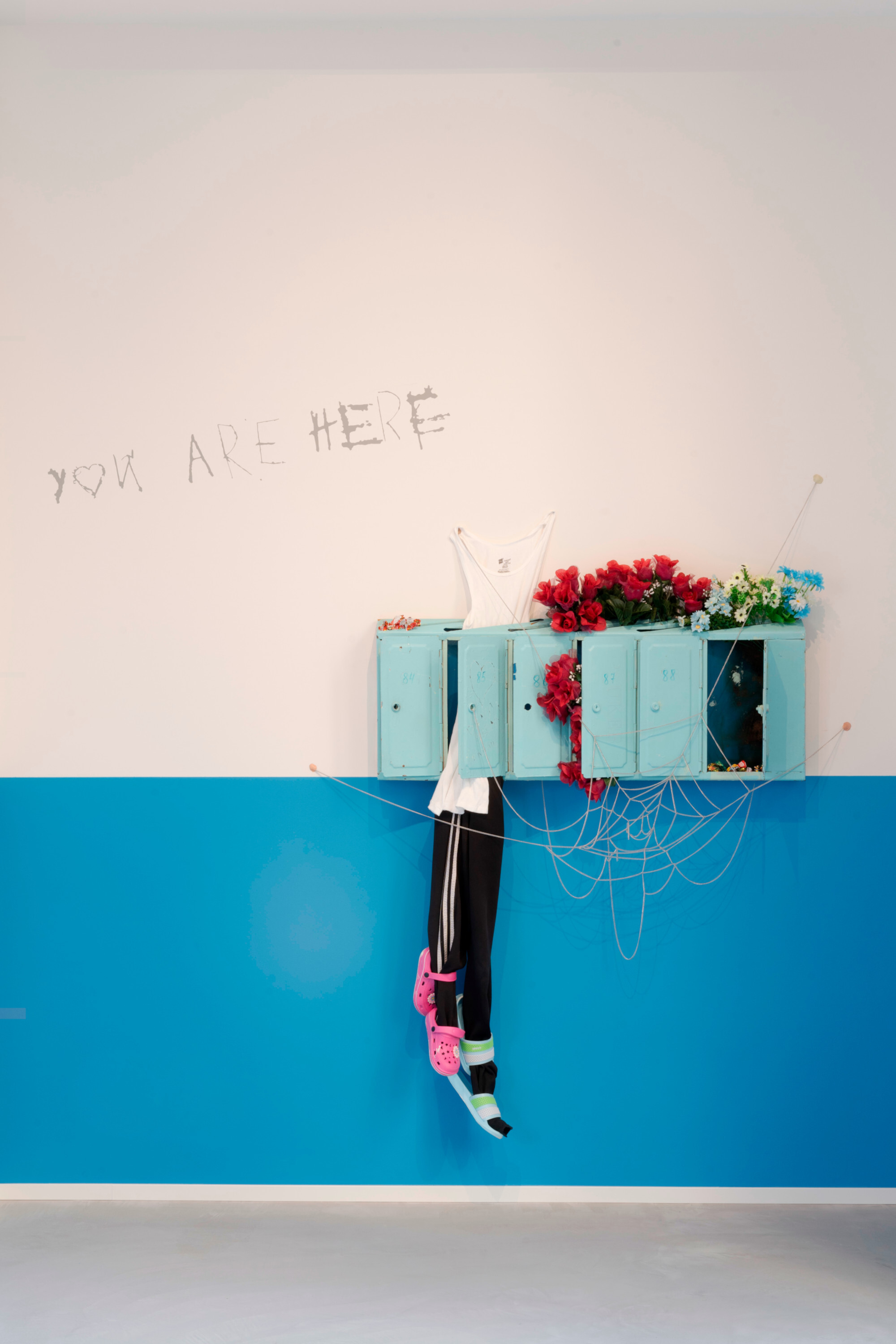


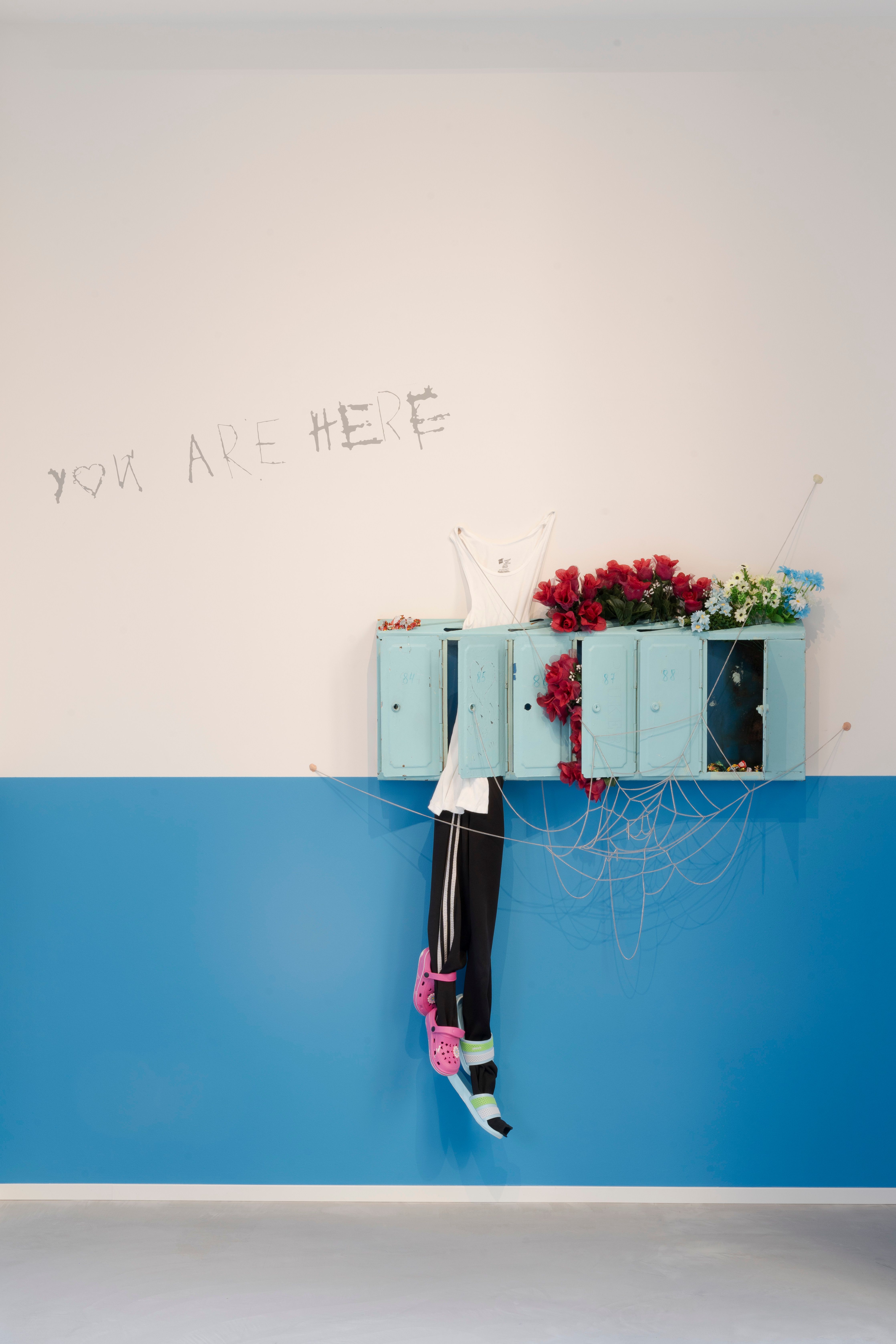
In their Rage Fantasies (2023), Akhmetova recreate pod’ezd: a communal entryway space between the street and the home, a familiar concept to many residents of Soviet-era apartment buildings. The surface of the walls in pod’ezd is visually segmented by paint: the bottom part of the wall is painted by either blue or green color, making it practical and easy to clean, whereas the top part remains white. The choice of blue and green is rooted in Soviet history: the green used for military and blue used for civil machinery. The abundance of these paints shaped the color palette or the pod’ezd environment. In this space, the metal mailbox serves as both a literal holder of mail and as a trash can for everyday items. The presence of plants and posters in pod’ezd represents the attempts to domesticate and personalize the communal space. For Akhmetova, this space is a sanctuary for intimate experiences. They describe their project as “about love, rage, and healing,” with heart imagery to represent emotions. Thinking about pod’ezd as a liminal space, Akhmetova reflect on high concentration of trapped passionate emotions: from sneaky teenage kisses and other mischief to overheard conversations, fights, and celebrations. The use of the word mahabbat (which means love) is intentional, as it appears in various languages and can be understood by a broader audience.
Through this project, Bazargali aims to create an emotional support hotline, designed to offer solace and reassurance to individuals dealing with trauma related to their homeland and the difficult decision to leave their country. This hotline is accessible through a website, as well as Telegram and Whatsapp, which are popular among diasporas around the world. Users are offered a selection menu that allows them to choose preferred language and form of emotional support. Through prerecorded voice messages in languages such as Qazaq, Kyrgyz, Uyghur, Uzbek, Tajik, English and Italian, visitors are met with words of encouragement and empathy. Voices of elder figures gently affirm: “You are doing great; you are not a bad person for choosing your comfort,” “You will always be welcomed back to your homeland,” “We are proud that people like you share knowledge about our region.” Bazargali hopes these messages serve as reminders to individuals of their resilience and strength.
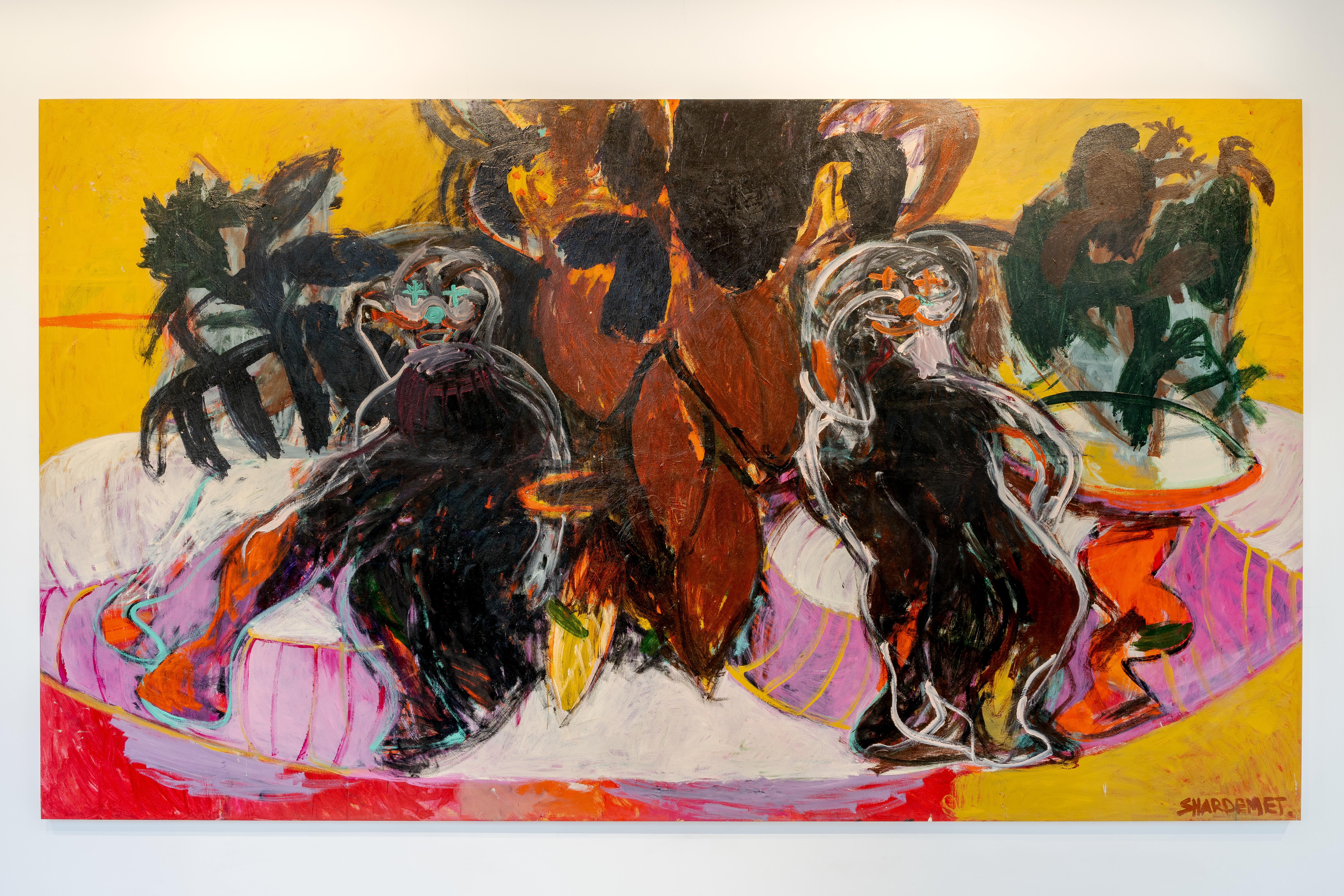
Nukus-based Temur Shardemetov’s main artistic medium is expressive figurative painting. The artist is part of the so-called “Nukus phenomenon,” which is an unofficial term designating a group of young painters all based in Nukus, the capital of Karakalpakstan, the autonomous republic within Uzbekistan, where they are now actively developing the local art scene. Shardemetov’s creation’s only purpose is to highlight the harmony between different living species which coexist in his paintings with no hierarchy. He produces both small-scale and large-scale artworks with the help of acrylic and oil paint.
Gulnur Mukazhanova’s installation adapted for the Foundation’s premises is the long looping line of the horizon consisting of the durable synthetic fabrics that are layered one on top of the other, disguising or showing the fragments of the layers underneath. This horizon line creates a space which connects all three levels of the foundation’s building, assuring continuity of the narrative behind the show. The layers of fabric might make one think of layers of memories, particularly those that seem to be long gone and forgotten yet remain always there. Some parts of the line are very busy and overwhelming while other parts are minimal, recalling the landscapes of the steppes from Mukazhanova’s home country, Kazakhstan. The artist uses the patterns of the fabric, mixing, cutting, blending, and melting the colors together, much like in painting.
As a community, Qizlar exist not only in the physical world and a specific geographical location, but also on various digital platforms, which play a key role in their activities. For many, the Internet has become an integral part of life, where identities intertwine within a rapidly changing technological landscape. The installation by Qizlar showcases a world of phygital connections, where emotions and experiences create a map-grid of the collective members’ relationships with each other and with their hometown, Tashkent. The multimedia work consists of various video and audio messages taken from Telegram messenger widely used in Uzbekistan. Recorded instantly, in a spur of the moment, these fragments transform into “mini-performances” for individual viewing. They create a soft presence, not imposing themselves, but at the same time establishing a moment of intimacy between participants. Within the multimedia installation, Telegram circles come to life within pendants, medallions, and round pins, which are characteristic of mass culture, often serving as souvenirs and mementos. The object’s circular shape also draws parallels with traditional talismans such as tumor and ko’zmunchoq, as well as with the semantics of the circle in Central Asian cultures.
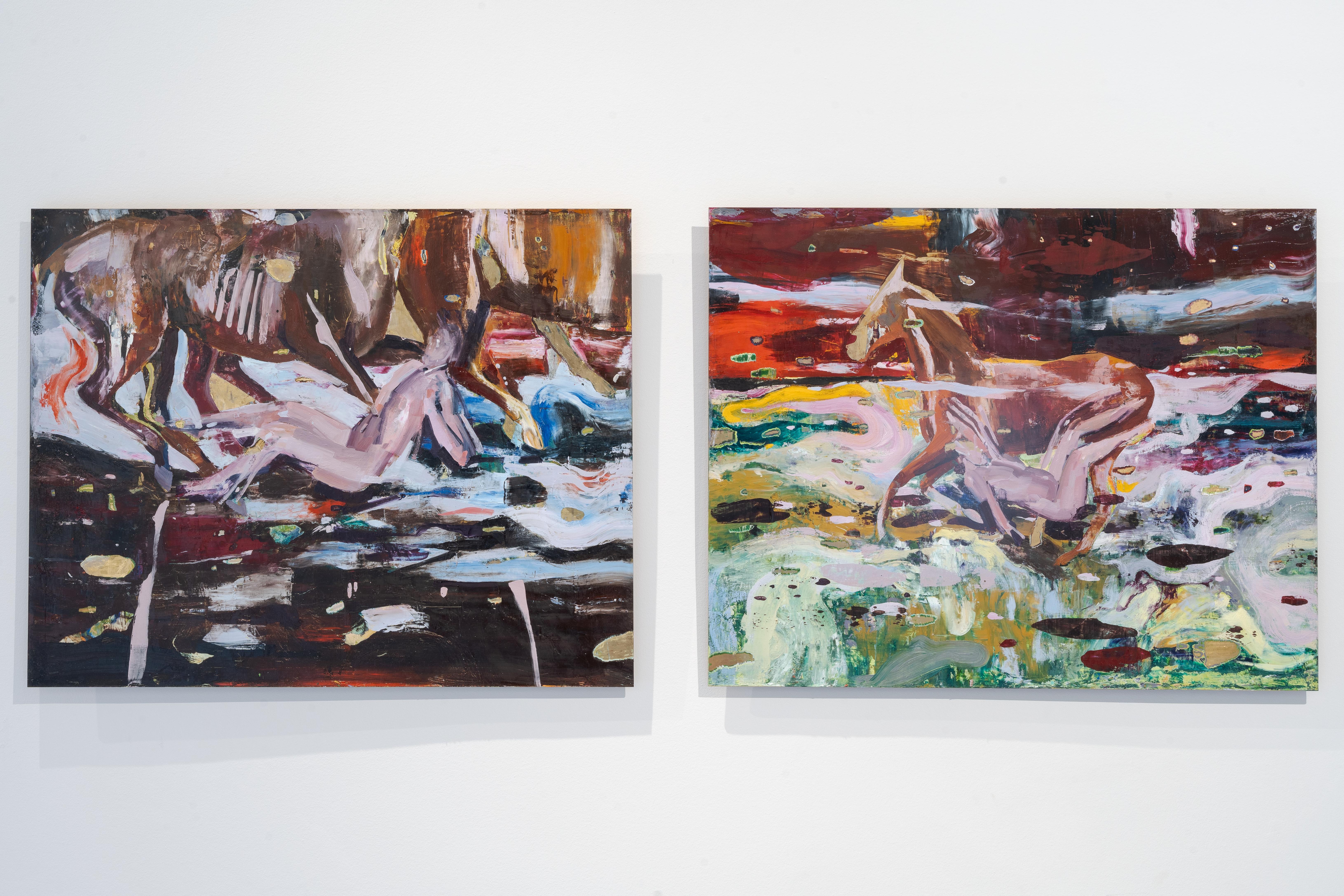
The Kazakhstani Nurbol Nurakhmet produced this new series of works specifically for the show. Largely experimental, the painting series Never Touch the Ground (2024) opens a new chapter in his artistic journey. Traditionally dealing with painting on canvas, the artist decided to use metal sheets this time, namely brass, as a medium. His idea of working on metal was motivated by tangibility and characteristics of this material compared to other, rather traditional supports. In fact, when painting on metal, one can remove the paint completely as if nothing was ever applied to its surface, resulting in an almost virgin sheet. With such an effect, Nurakhmet sought to translate plastically the idea of lost and rewritten history.
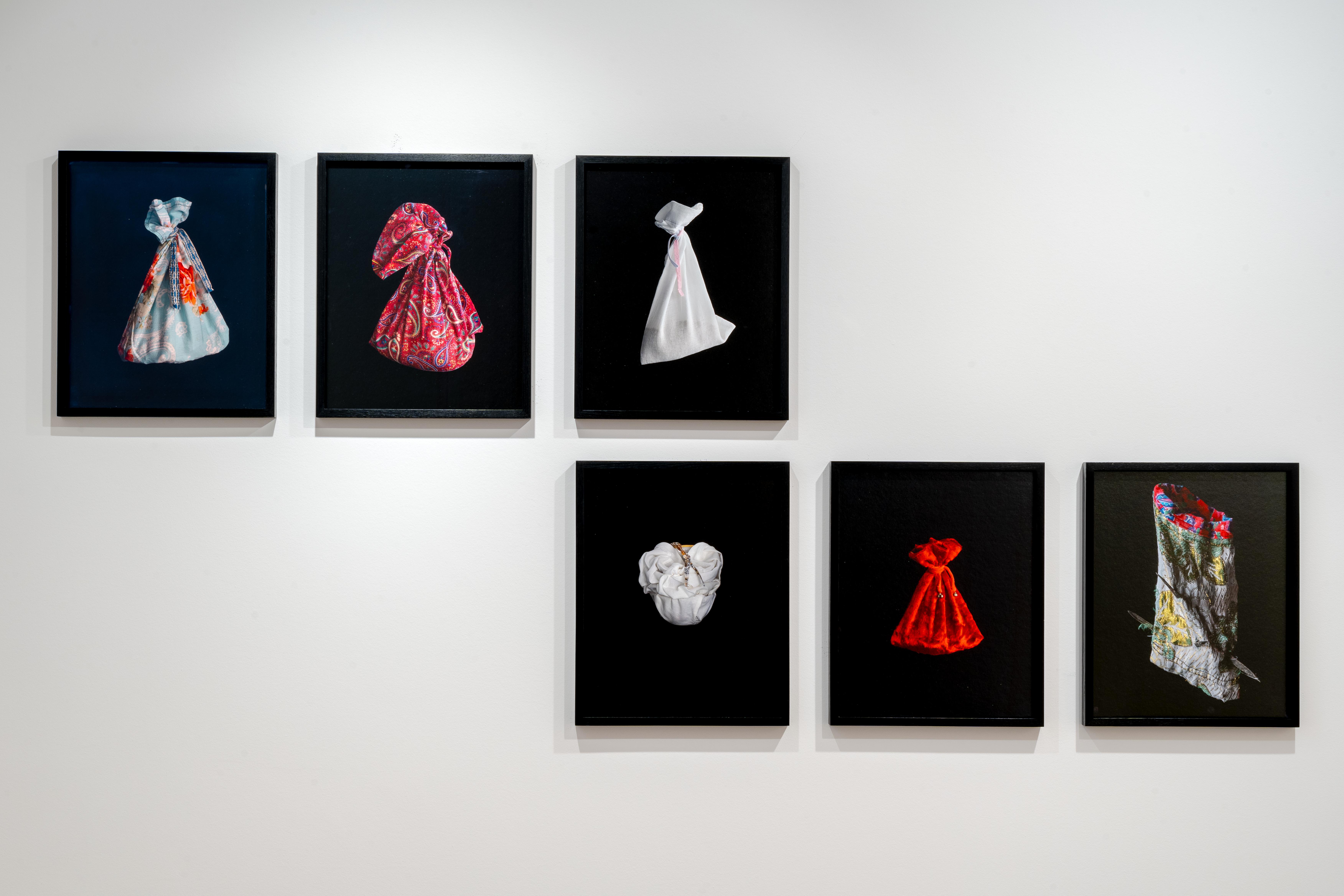
The photographic series Jeti Qaraqshy (2023) whose title was inspired by the constellation Ursa Major, demonstrates different qalta, meaning pockets or bags in the Kazakh language. Captured by the artist, they were all hand-sewn by Aïda Adilbek’s own grandmother. Using these qalta the grandmother would bring gifts, money and jewelry as well as jasau, or dowry items (like a set of table dishes) from her home region in Western Kazakhstan when visiting her grand daughter in Almaty. The series thus highlights the precious act of intergenerational transmission between different women of one family.
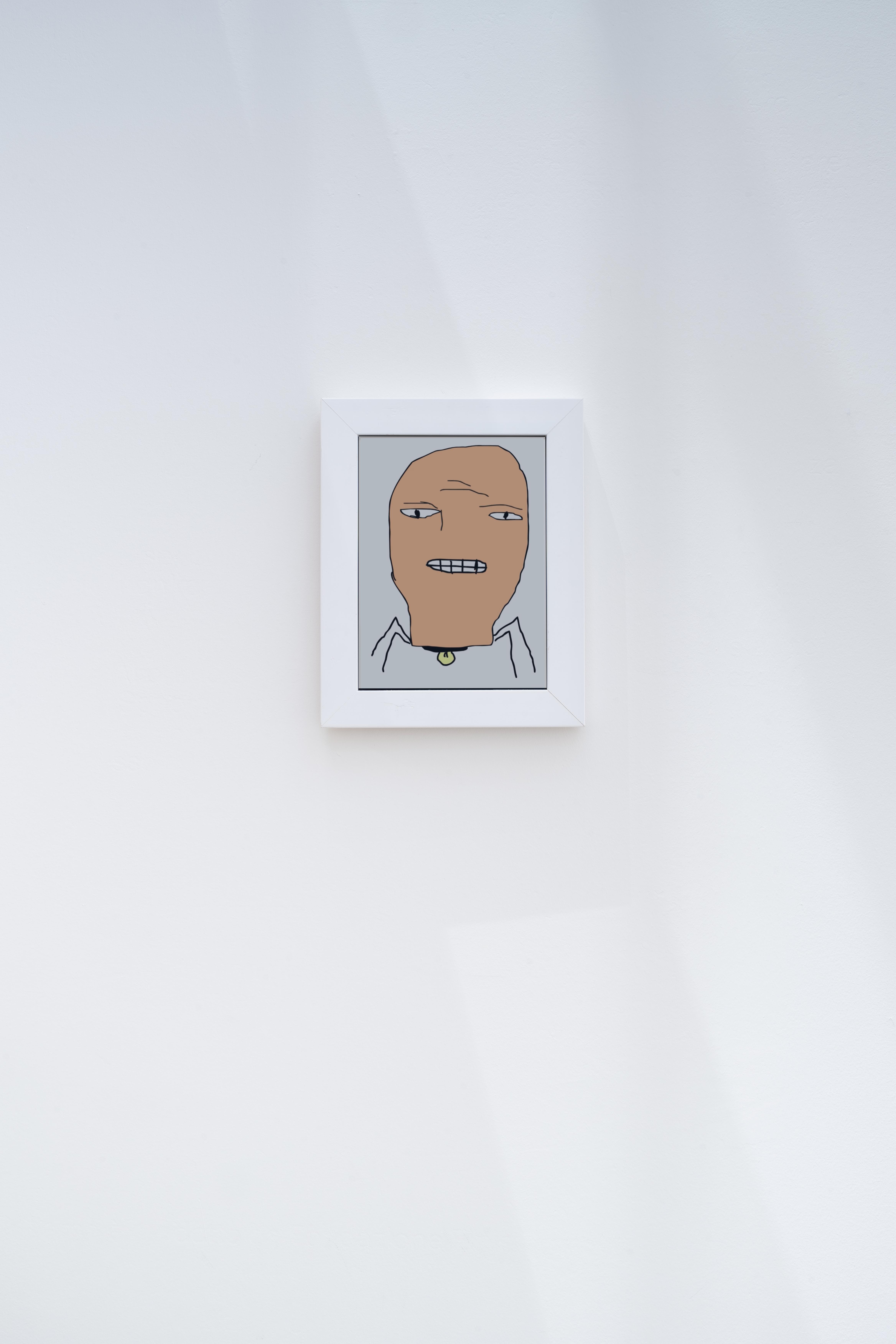
With almost no plot, Rayimkulov’s animations are small sketches brought to life. “My animations capture a moment of something physical, emotional, and existential, which needs to be documented. Otherwise, I will burst,” he explains. As he moved from one place to another, he had no permanent workspace. Everywhere he would go, he felt like a guest, often facing so much pressure. That experience shaped his very minimalist style, which he developed while being constantly on the move. Raiymkulov’s animations are portrayals of place, time, and the presence of a little person within.
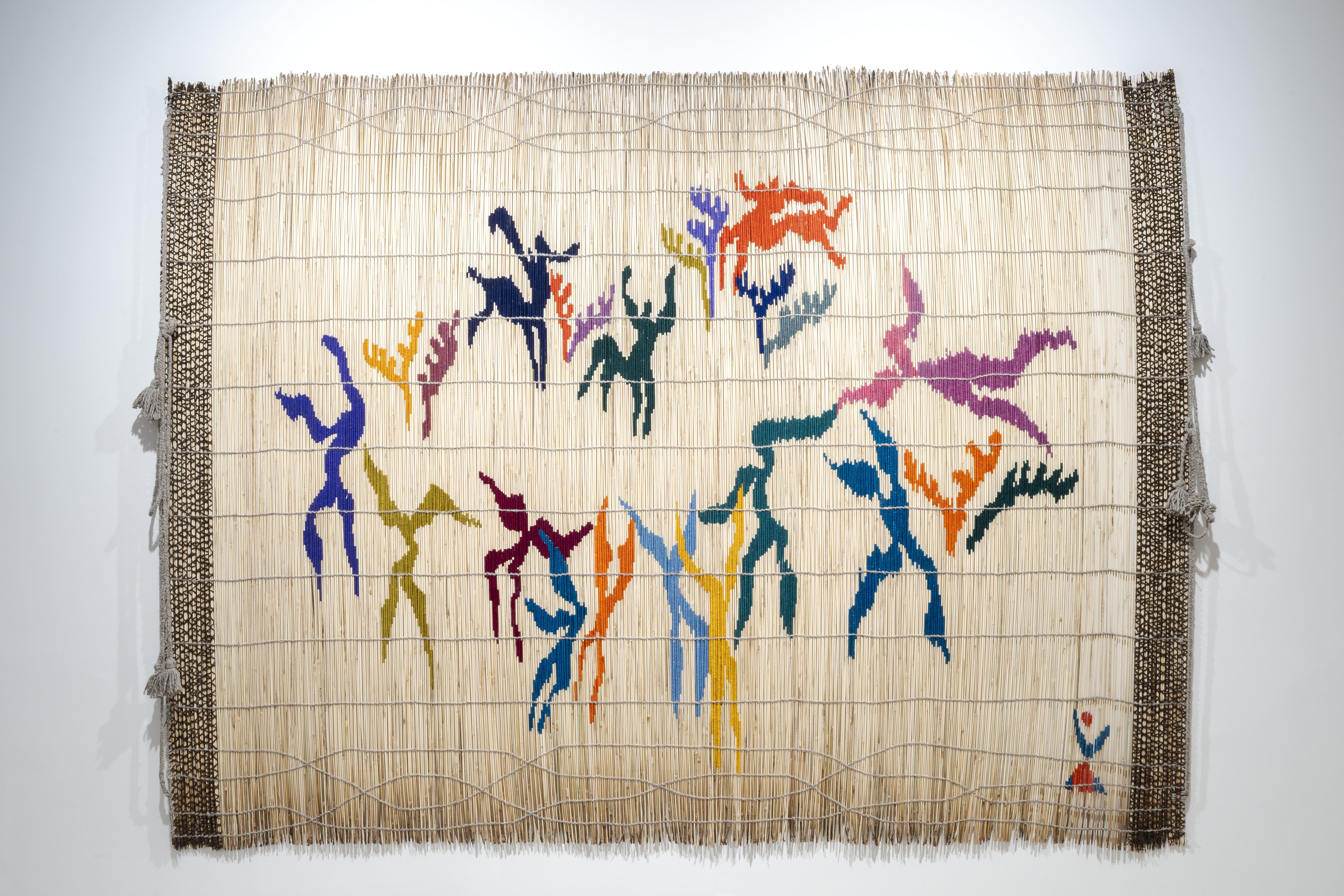
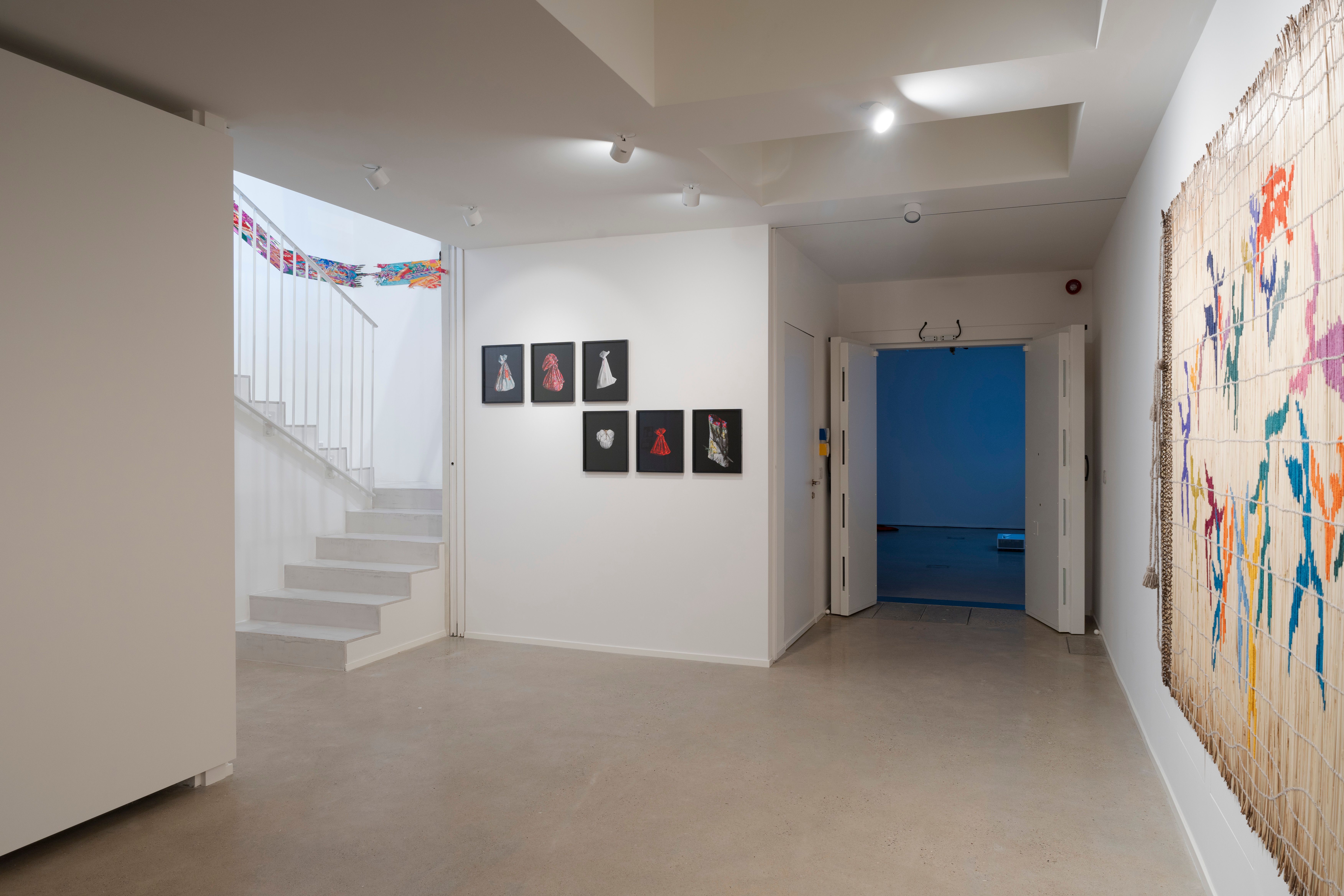
For Jolchu, the main inspiration for her artwork comes from her cherished memories, stories, and craft making knowledge passed down from her grandparents, with whom she was raised. Immersing herself in the memories of floating deformed patterns, Jolchu found her unique artistic style. She recalls how her grandmother would sit on her favorite trestle bed, spin woolen threads, and create patterns while sharing stories. In this trestle bed, surrounded by patterns and saturated with the aroma of felt, Jolchu felt the fullness of life. In her imagination, these pattern scame to life in various distorted forms, becoming a small world in which she found herself. One of the Kyrgyz traditional crafts Jolchu learned from her relatives is making reed screens, a complex laborious form of art in Central Asia. These panels are made from tall grass stems called chiy. Each stem is hand picked, cleaned, and is wrapped separately with wool of various colors. When bound together, these stems make an intricate pattern.
Raiymkulova’s art frequently reflects on such questions as the meaning of existence and humanity. In her work, she finds herself as an otherworldly biomorphic creature tucked away in the cracks of the wall. Raiymkulova’s works are deeply connected with her personal experience and identity as a daughter, woman, and citizen. Reflecting on her artistic approaches, Raiymkulova questions: “Who am I? And how did I end up here?” The objects that she creates are reflections on these inquiries, everything that usually remains overlooked or unsaid. She is particularly interested in how we develop habits and are mentality influenced by the conditions of everyday life. This inspires her to work with the things that shape our environment but may remain unnoticed. For instance, the graphics she creates resemble the wall with cracks, where biomorphic creatures strive to inhabit seeking to capture more space.
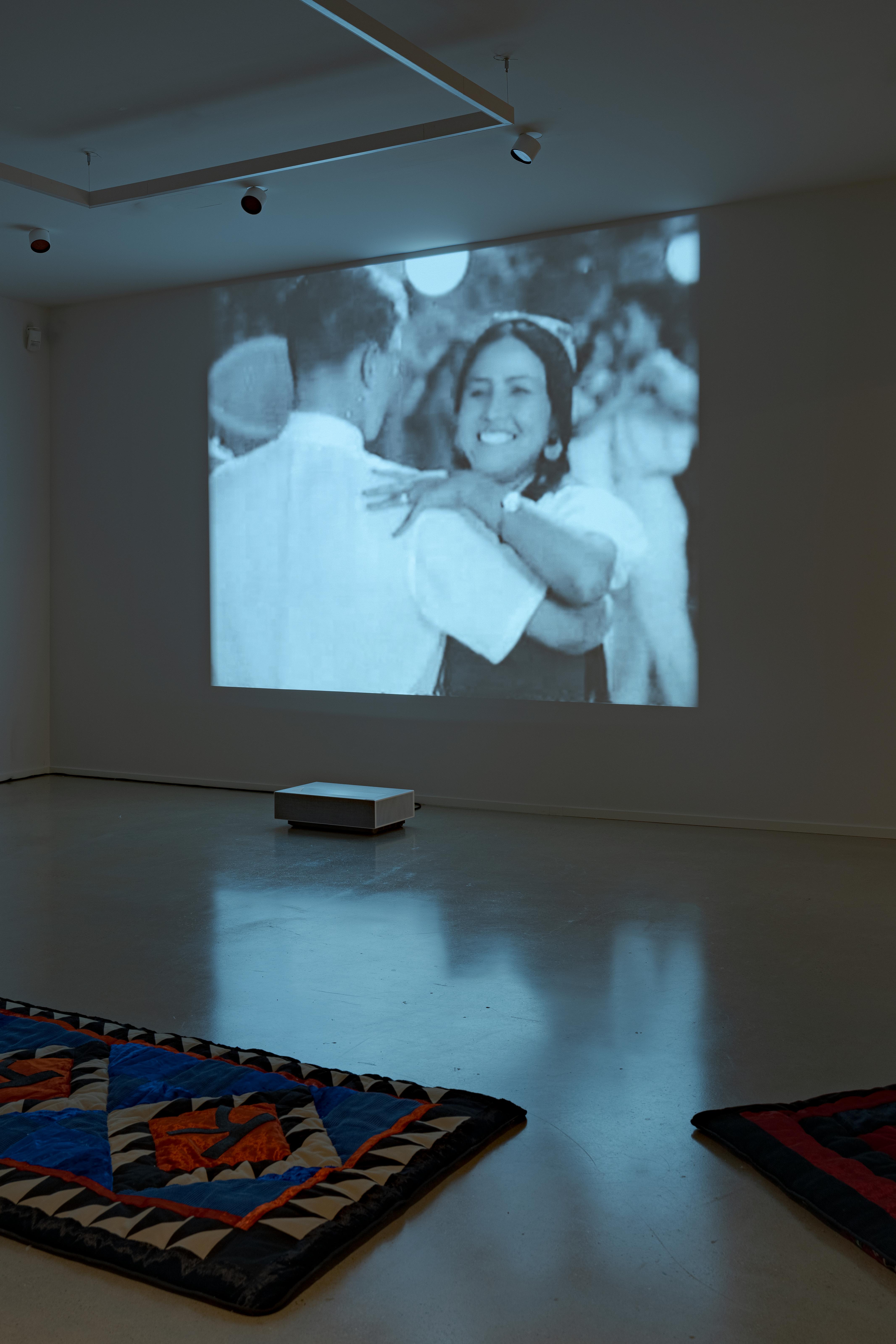
Saodat Ismailova’s video essay Her Five Lives (2020) focuses on the evolution of female heroine archetypes in Uzbek cinema. Starting from the early Soviet period, the artist and filmmaker ends her piece with the films of independent Uzbekistan, drawing a vivid and ever-changing portrait of an Uzbek woman as captured by the cinematic gaze. The modern history of Uzbekistan is thus told through the history of the country’s films.
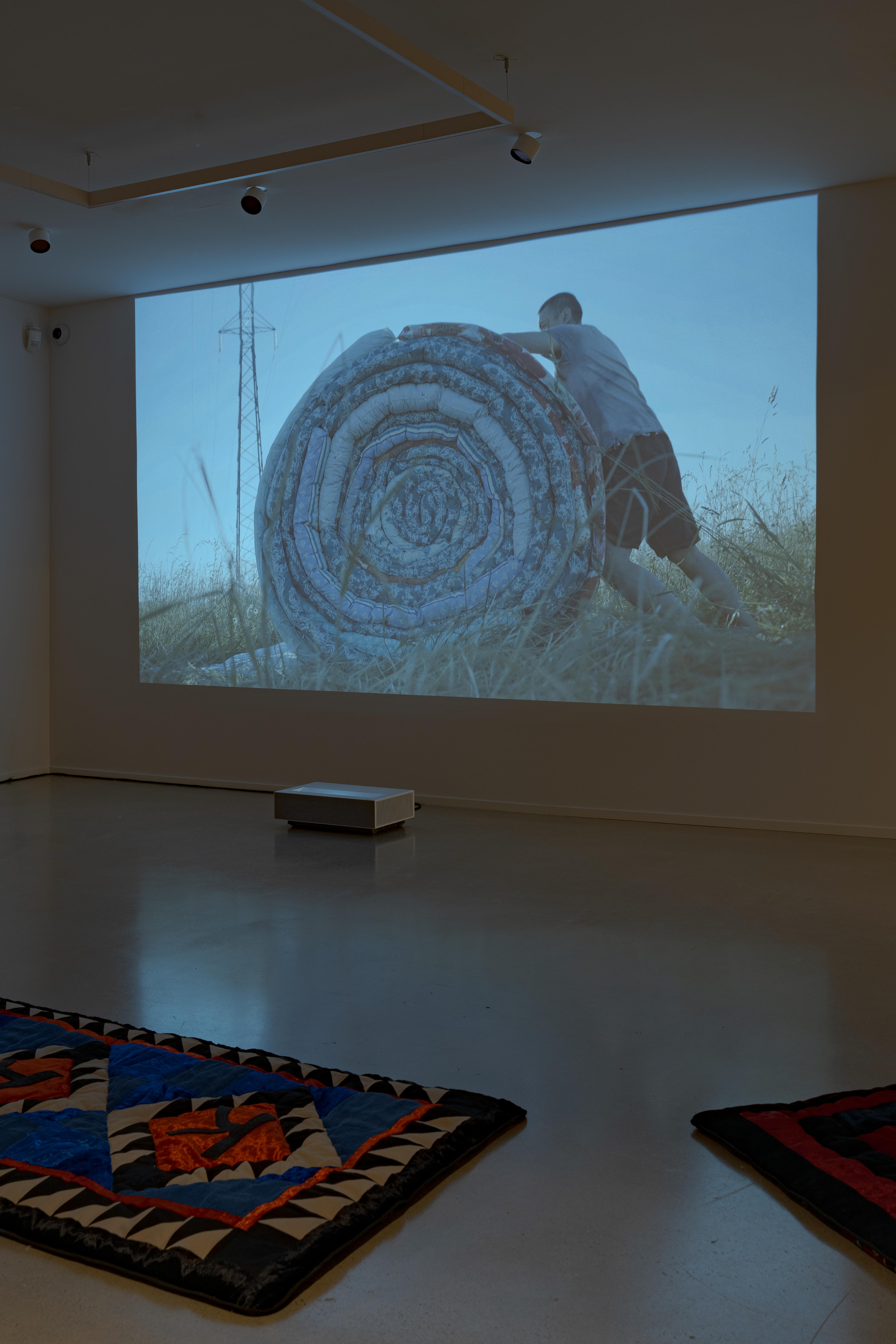
Aidarov created this work while living and working as a labor migrant in Moscow. He traded 27 used mattresses with his fellow co-workers for new ones and stitched them together to make a long “sheet.” This sheet is a collective image of the lives of his acquaintances being exploited at a construction site with no days off. Aidarov took the sheet out into the field and folded it into a large roll exceeding his own height. Aidarov says that the idea for the performance came to him when, as a labor migrant himself, he worked as a loader at a confectionery factory and lived in so-called “rubber” apartments with 20–30 people, who pay monthly for a “bedspace.” In fact, a bedspace is a standard mattress (200×80 cm or 200×90cm). In such conditions, making the bed makes no sense: after sleeping, the mattress is simply rolled up. The artist recalls that after three months of working without a day off, “time and its perception transform, a person simply loses connection with time, and life is measured only by the rolling and unrolling of the mattress.”
Produced in 2020, Looking for You is a web-portrait of Uzbekistan as imagined by Azadbek Bekchanov, who was born there, but now lives in Europe. The artist is particularly interested in the way technology affects our perceptions of reality and the ambiguity that arises in this back-and-forth between the virtual and the non-virtual through different typologies of images. Bekchanov seeks to imagine a homeland, a dreamed place that blends personal memories, images taken from the internet and transmitted stories.
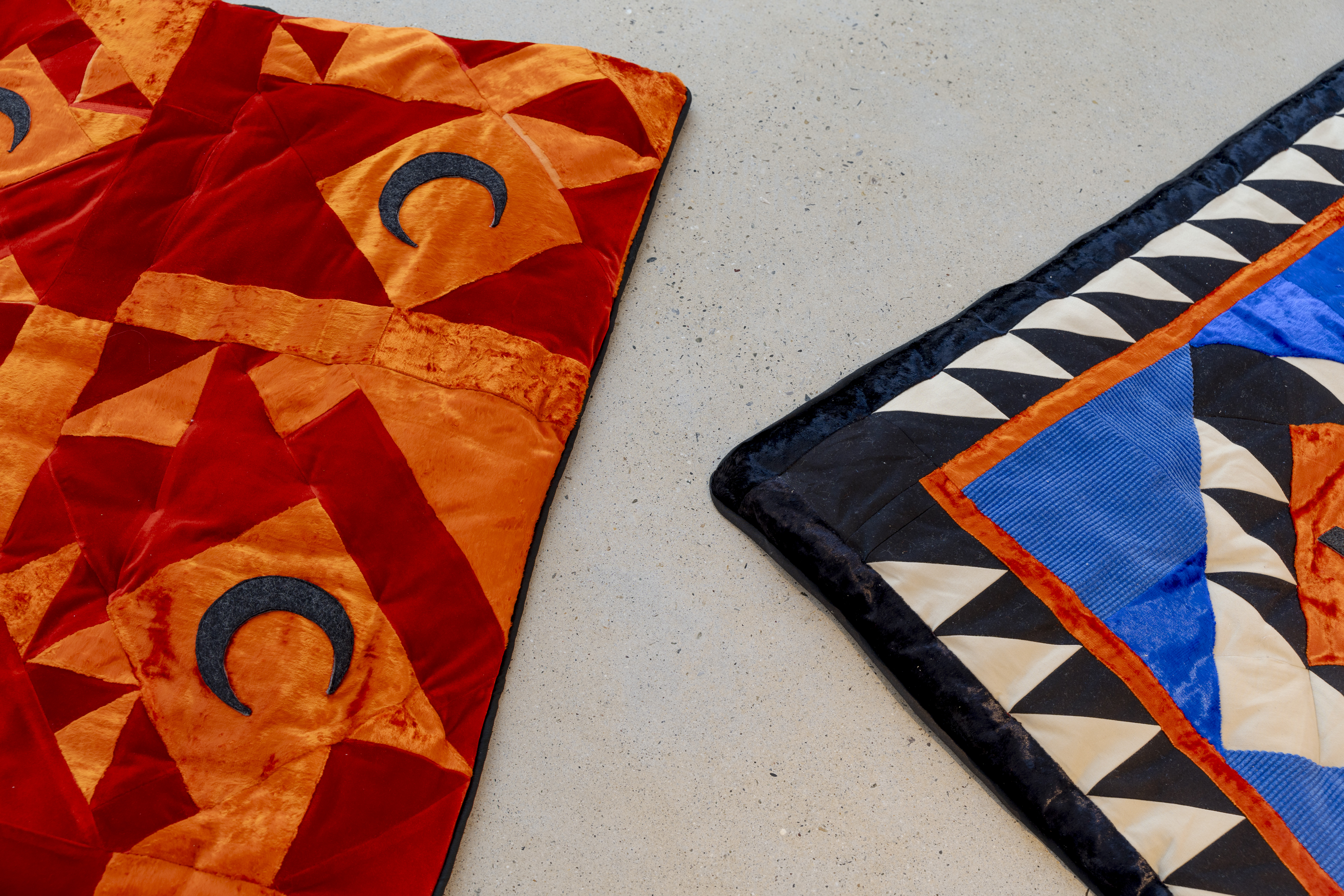
As an artist and architect, Abdukakharova’s artwork focuses on life in Bishkek, capital of Kyrgyzstan, exploring the challenges of urban living, social pressures, and environmental issues. By blending traditional Kyrgyz techniques with contemporary themes, she uses the Kyrgyz traditional floor mattress, known as toshok, to convey everyday thoughts. In her work Down the Soviet – Up the Manas (2024), Abdukakharova refers to the names of Bishkek’s streets that are used as public transportation routes and metaphorically employs them to reflect on the country’s future directions. She ponders as to whether we must always be on some limited, predetermined paths, such as going down Sovetskaya Street and going up on Manas Prospect, making a mandatory stop on Kievskaya Street. She wonders whether the new routes are being imposed upon us today. Talking about Manas Prospect, where the Moscow complexis being built, and moving along Jibek Jolu, the Silk Road, where the central mosque is being constructed, she wonders to what extent moving along any of these paths provides a sense of home. For her personally, the feeling of home is evoked by toshok, even in the absence of home.
Through his research, storytelling, and a series of felt panels, Tilekov explores labyrinths as imprints of human existence. Depictions of labyrinths such as Knossos labyrinth can be found in many parts of the world. The oldest image is over 3,000 years old and it is linked to the myth of Daedalus, who, according to legend, created the labyrinth on the island of Crete to contain the Minotaur. In Kyrgyzstan, three depictions of this labyrinth are known as petroglyphs. The path through the labyrinth symbolizes the life journey of a person – from birth to death. During one of Tilekov’s tours with the Kyrgyz music ensemble in the US, he met a Shoshone man in Wyoming. This meeting revealed a striking similarity between the local Shoshone and the Kyrgyz people, which made them consider the idea that there is a kinship between their cultures. “The connection certainly exists, but the paths of our common ancestors diverged many thousands of years ago,” Tilekov reflects.
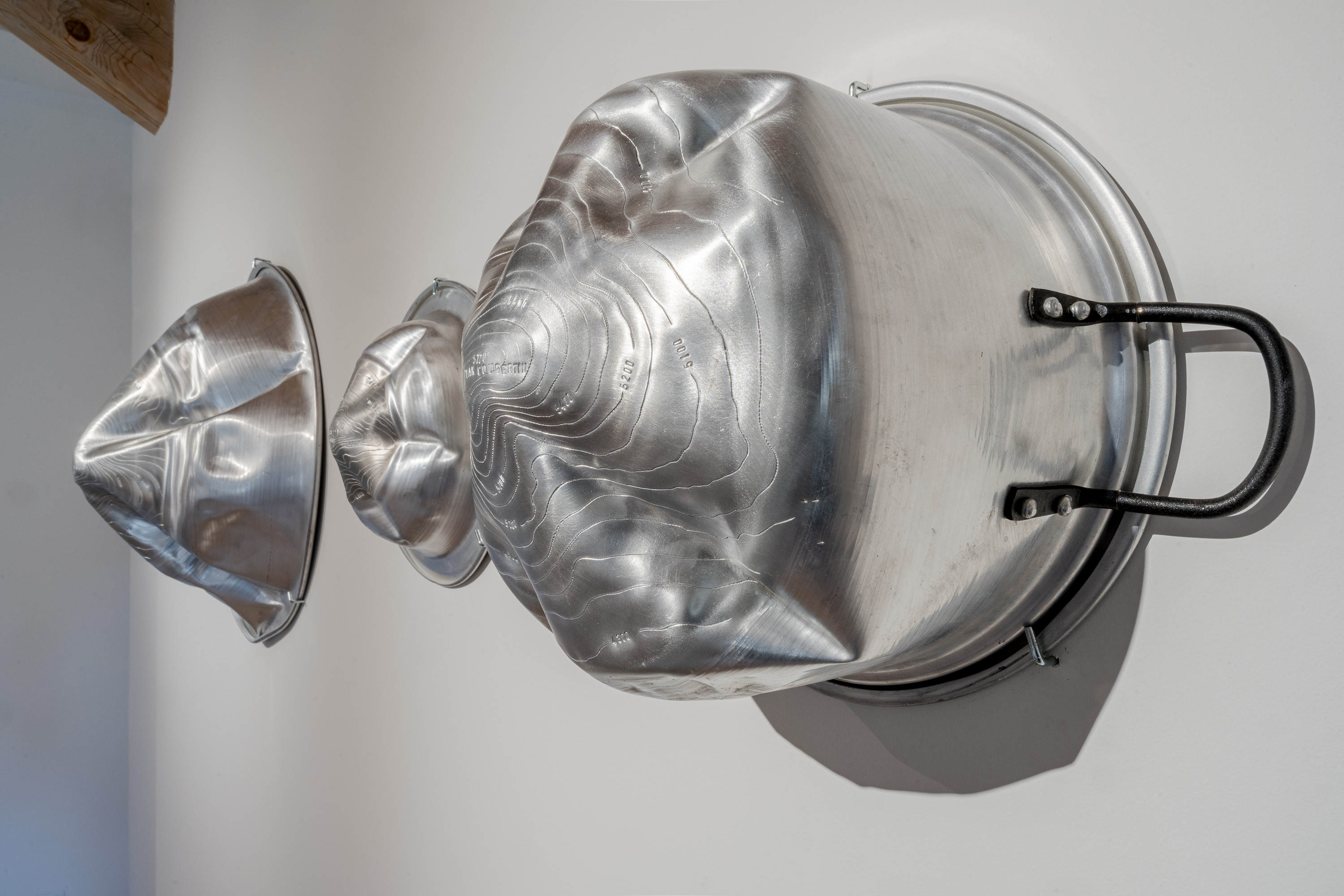
The People’s Commissariat for Internal Affairs, abbreviated as NKVD, was the central government body of the USSR responsible for combating crime and maintaining public order from 1934 to 1946.In fact, the four letters in the institution’s title were mostly associated with violent mass repressions. Named NKVD (2020–21), Yerbossyn Meldibekov’s installation consists of four aluminum basins with characteristic groove lines resembling topographic maps, where irregularities and height differences are indicated by the spacing between the lines. The artist deformed the original strict order of the lines so that the disrupted arrangement creates a topographic image of a mountain relief, enhanced by engraved marking points and the names of Central Asian mountain peaks. Peak NKVD now bears the name of Pierre de Coubertin, but there have been other names changed for political reasons. Initially called Peak Yagoda, it was renamed to Beria, NKVD, and then Coubertin. Meldibekov collects and combines all the names that once existed into a single mountain peak, creating a non-existent landscape, a false picture of the world, where geographical parallels become historical ones.
Vyacheslav Akhunov, artista di base a Tashkent, presenta un progetto congiunto con la sua apprendista e collega Ester Sheynfeld. Tecnicamente due opere d’arte separate, queste si completano a vicenda, creando un tutt’uno. The Disappearance (2024) (La scomparsa) di Vyacheslav Akhunov prevede la cancellazione letterale di parti di testo, fotografie e immagini da parte dell’artista, creando così distruzione, o meglio decostruzione. Questo gesto brutale sottolinea la fragilità della memoria umana e la cancellazione dei ricordi, la sua natura frammentaria e la dimenticanza intenzionale. Ciò è particolarmente rilevante quando si tratta di eventi e fatti storici, ovvero dell’alterazione deliberata del passato cancellato dalla memoria pubblica e storica per lasciare uno spazio vuoto, che viene poi riempito con un altro significato, spesso opposto.
Ester Sheynfeld’s Dust (2024) consists of carefully collecting, preserving and disposing of the dust produced by Akhunov’s gesture of erasure in medical petri dishes. These as ashes become a symbol of not only intelligence, but also of the sacredness of accumulated knowledge, experience, which one wants to imprint forever, despite their slow destruction by time and unforeseen circumstances. Overall, the project also demonstrates the process of transmission between different generations of Central Asian contemporary artists.
Working on construction sites in foreign countries, labor migrants spend years away from home, building cities that are not their own. The only connection migrants have with their homeland is through phone calls and letters. And everything they learn from their loved ones over the phone and from letters—all their experiences, thoughts, fears, and worries—they silently weave into their monotonous work, tucking between the bricks, embedding them into the wall. The traditional Ikat fabric between the bricks serves both as a binding element and as a carrier of workers’ sweat and stories.
New Patterns for Suzani: Tree Stumps (2024), is Ivanova’s series of textile art that reflects on profound social, political, cultural shifts taking place in Uzbekistan. Drawing on the centuries-old Central Asian rich tradition of Suzani embroidery, Ivanova reinvents the craft by
introducing the contemporary narratives such as environmental and industrial exploitation, rapid modernization and transformation, as well as a role of women in society. New Patterns for Suzani: Tree Stumps (2024) is a vibrant textile collage created on traditional Ikat fabric, where the circular tree stumps are carefully assembled from fabric scraps and detailed with hand embroidery and acrylic paint. The silhouettes of buildings along the perimeter frame portray the rapid construction that re shapes Uzbekistan’s landscape, offering a visual narrative of both loss and renewal.
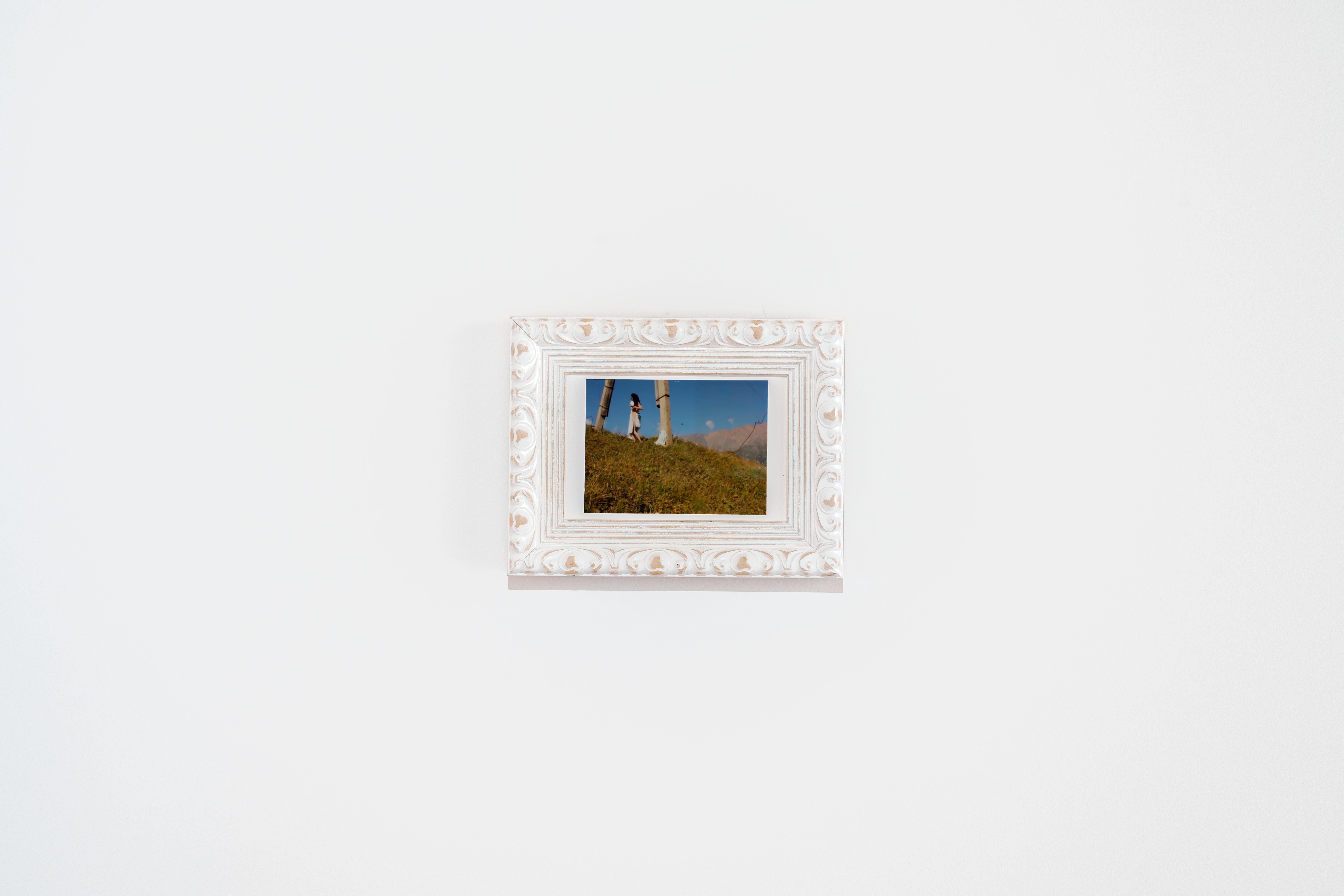
The video performance Sebastian (2013) stages a half-naked androgynous figure represented by the artist herself standing in the classical pose from St. Sebastian’s iconography, tied to an electricity pole somewhere near Almaty, who suddenly acquires gender and turns out to be a young woman hanging out clothes on a line. The work looks like a performed sketch, made on the spot with basic available means (filmed on an early 2010s mobile phone and unedited). Such a straightforward approach convincingly demonstrates uncompromised manifestation of the artist in search of a gender-neutral world. Ironic as it is, the work turns the tragic death of the saint into an episode of everyday routine.
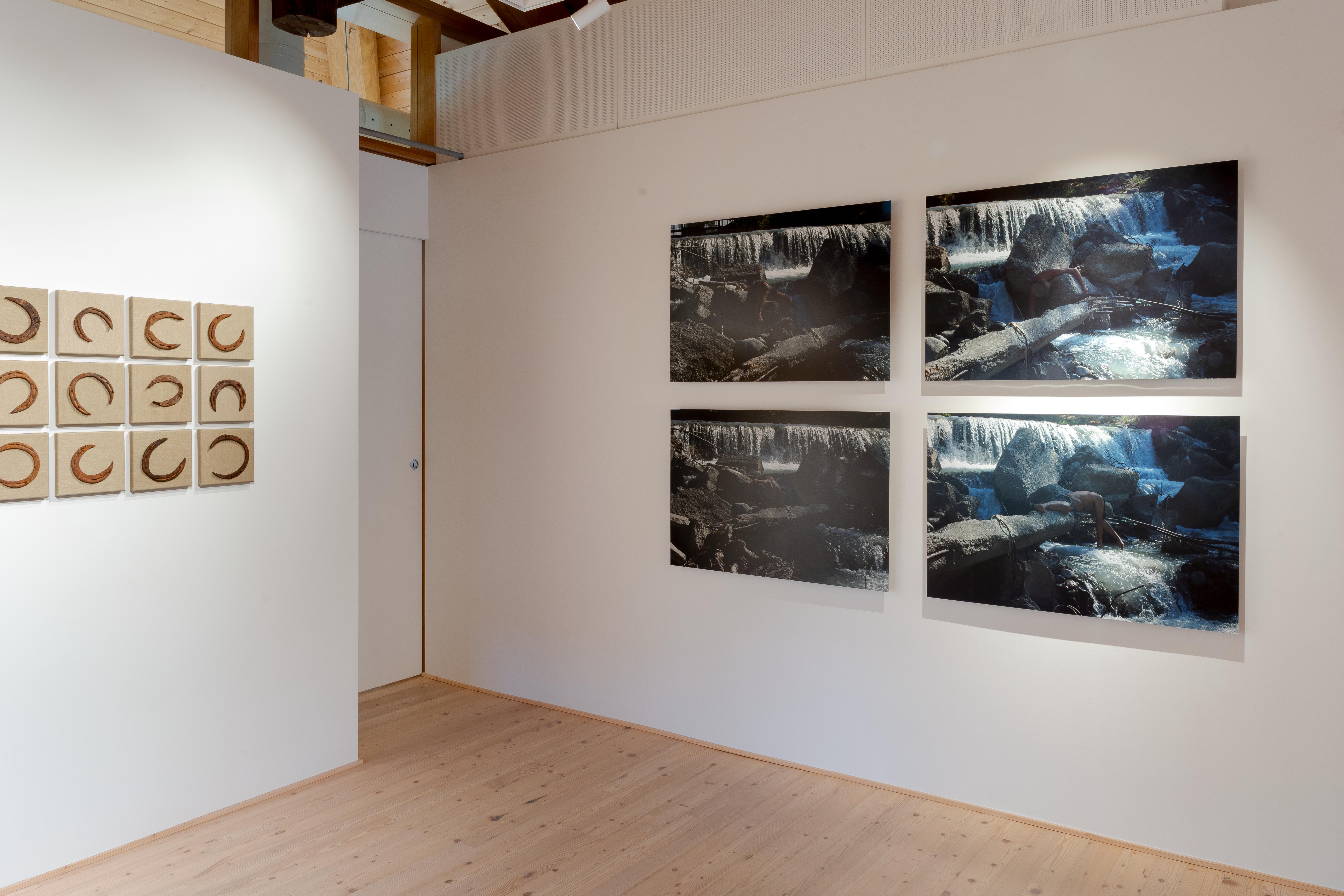
In his performance River Dwellers (2024), Ulan Djaparov immerses himself into the realm of the natural world, blending between man and environment. Located near Bishkek, the river lives its own life, flowing through a concrete channel, where water appears and disappears, revealing what’s hidden beneath. Trash has become an integral part of the landscape, transforming the originally natural phenomenon into urban marginal space. “Bodies like trash... every time clearing away garbage, there isa light feeling of disgust, curiosity, and fear... fear of finding something unpleasant or traces of crime. Trash in the river – these are traces of small crimes,” says Djaparov reflecting on his work.
Corporeality is a key theme in Zhanel Shakhan’s multimedia practice, through which she explores the female body as a vessel of both life and resistance. Her soft sculpture Tar (2024) – meaning “cramped” in the Kazakh language – manifests the experience of women, who are frequently perceived as being “too much” for the roles imposed by the social contexts: too bold, too active, too outspoken .The sculpture takes the form of a female body with oversized hands turned into a round knot, like a tumbleweed roaming in space, it portrays both stagnation and movement. In confronting this issue, Shakhan highlights how women’s bodies are scrutinized, tamed, and controlled.
Said Atabekov’s installation Bir Ai (2024) can be translated as “one moon” from the Kazakh language. Nevertheless, it consists of 31 moons, all of which are represented by the metal horseshoes. Central to the nomadic traditional culture of Kazakhs, the horseshoe is a visually strong symbol which can be interpreted differently, depending on context. Thanks to its crescent shape, it evokes the moon and is often associated with various moon gods that are believed to bring luck and protect people. The horseshoe is also an ultimate syncretic symbol, as it visually reminds both the Soviet sickle and Muslim crescent, referring to political and religious systems that have impacted the Central Asian region.
Survey markers, also called survey marks, survey monuments, or geodetic marks, are objects placed to mark key survey points on the Earth’s surface. They are traditionally used for geodetic and land-surveying purposes. The artist Rashid Nurekeyev creates such survey monuments that he then transforms into art pieces, placing at their top a fox head. For him, such markers are ways of mapping the world, of marking one’s own territory. There are survey markers now installed by the artist in Almaty, Turkestan and Kyzylorda regions in Kazakhstan. This one is the first to symbolically mark Italy.
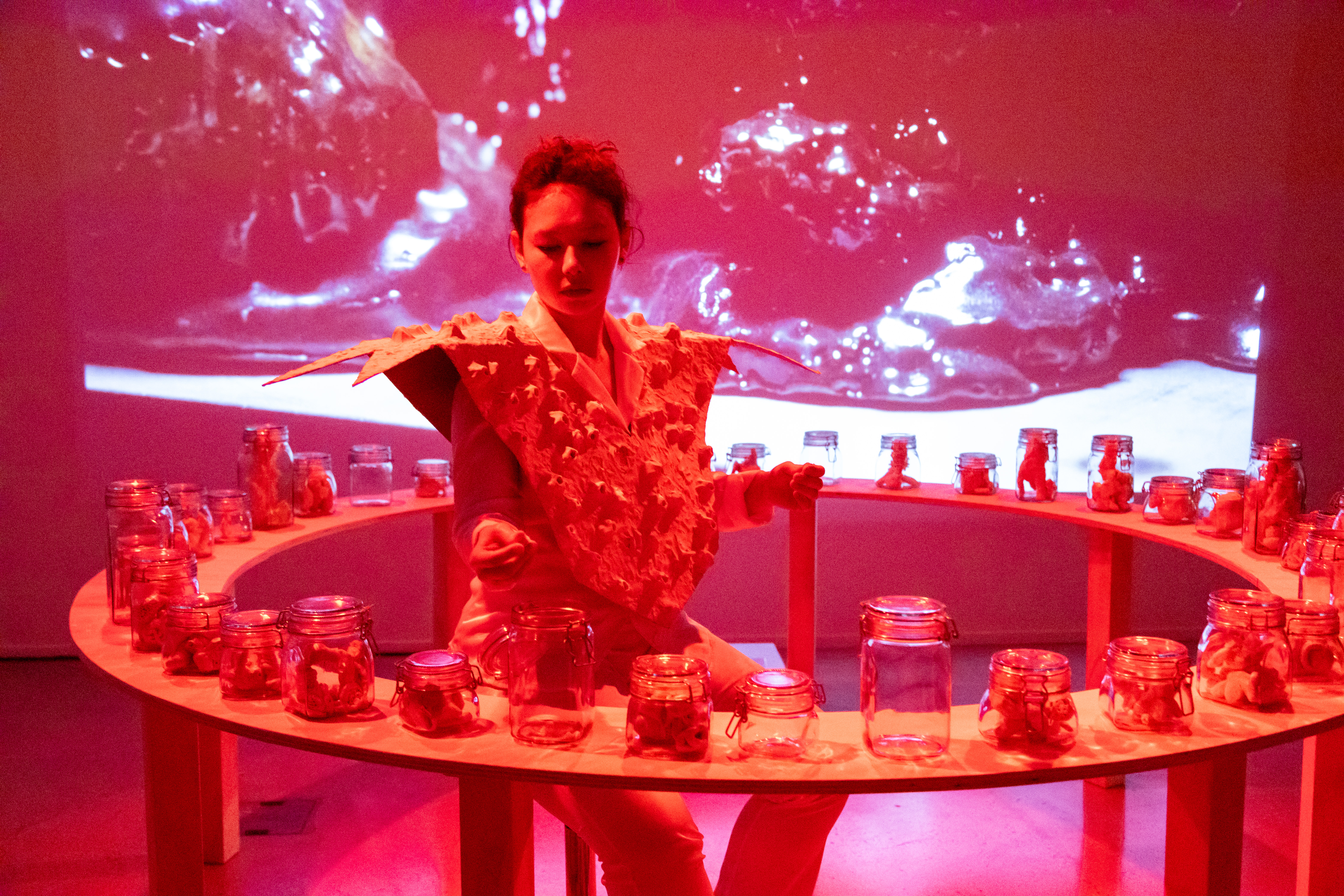
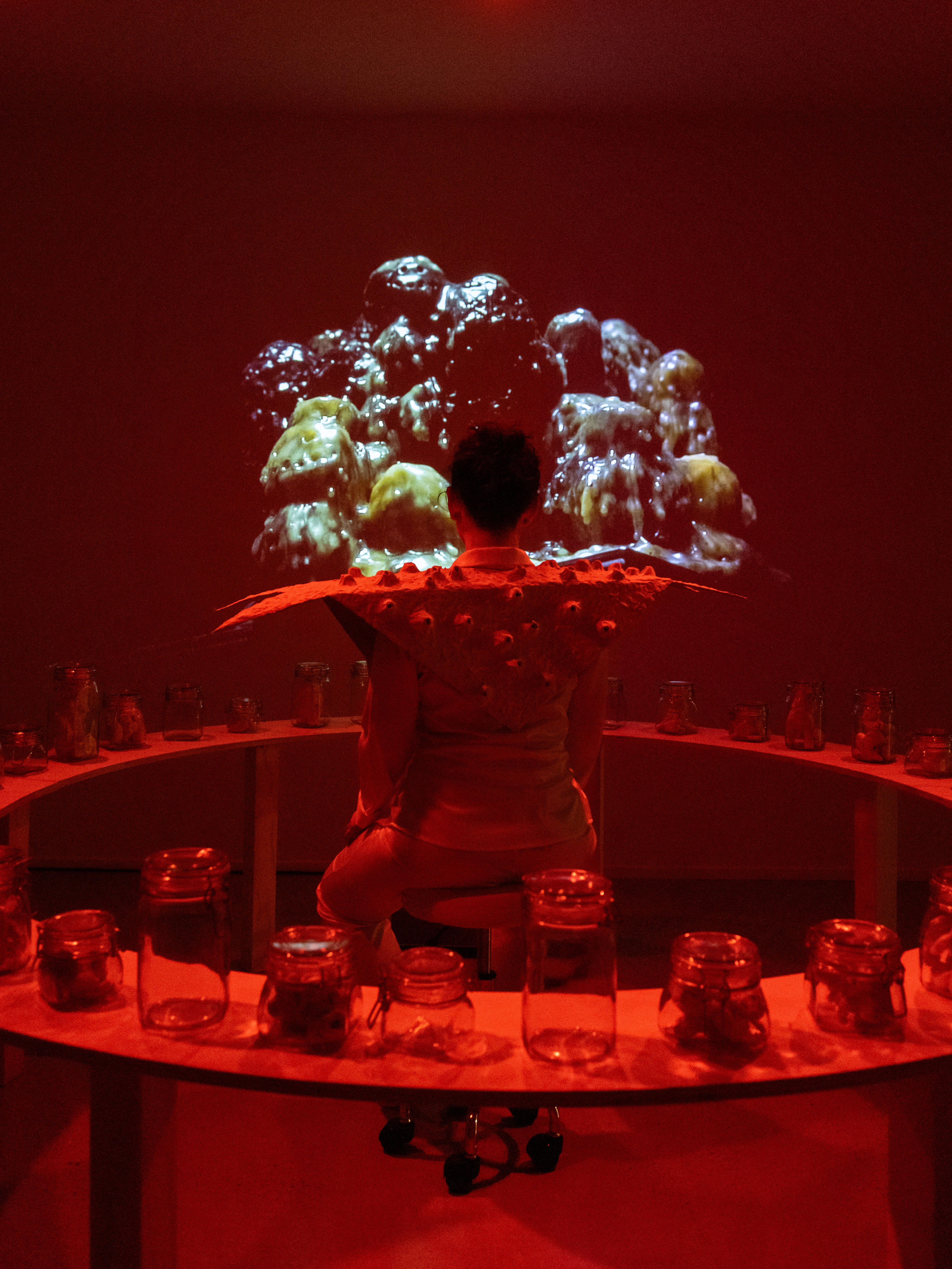
The Other Skin (2022) was originally conceived as part of the public program of DAVRA research group for Saodat Ismailova’s participation at documenta15. The primary medium employed during the performance is plasticine, a material typically used by children. Its capacity for continuous transformation mirrors chilltans,forty shape shifting spirits from Central Asian mythology. Like many children, Daria Kim used to tell her parents about creatures inhabiting their house—entities they couldn’t see. The artist found herself revisiting this moment when she ceased to perceive them. Positioned before Kim are 40 glass jars, and taking plasticine from herself, she sculpts elusive creatures, sealing them within. This act prompts questions about their current whereabouts, potential dangers, or even imprisonment. The Other Skin explores the delicate boundary between reality and imagination, utilizing plasticine’s adaptability to echo the fluid nature of perception.
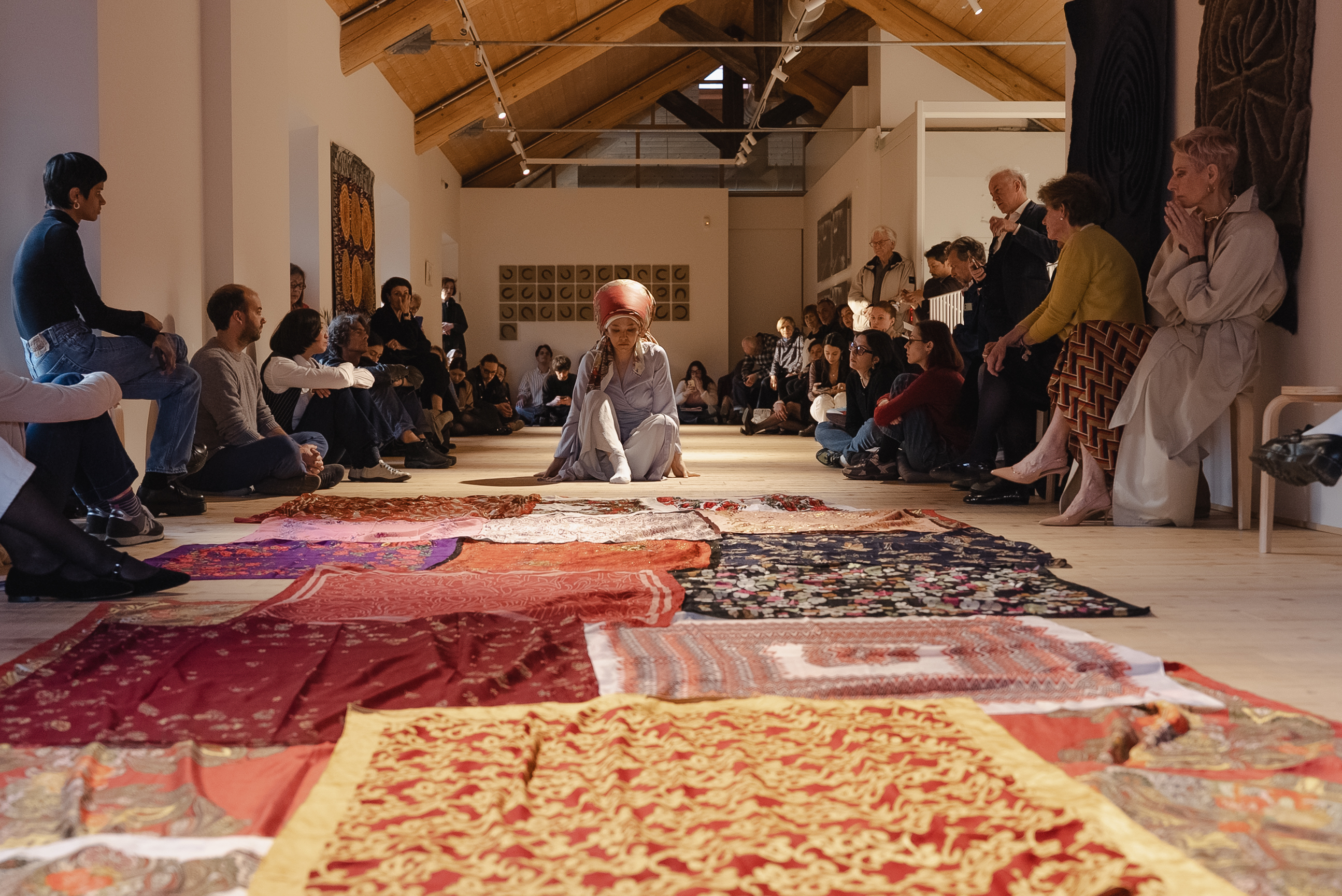
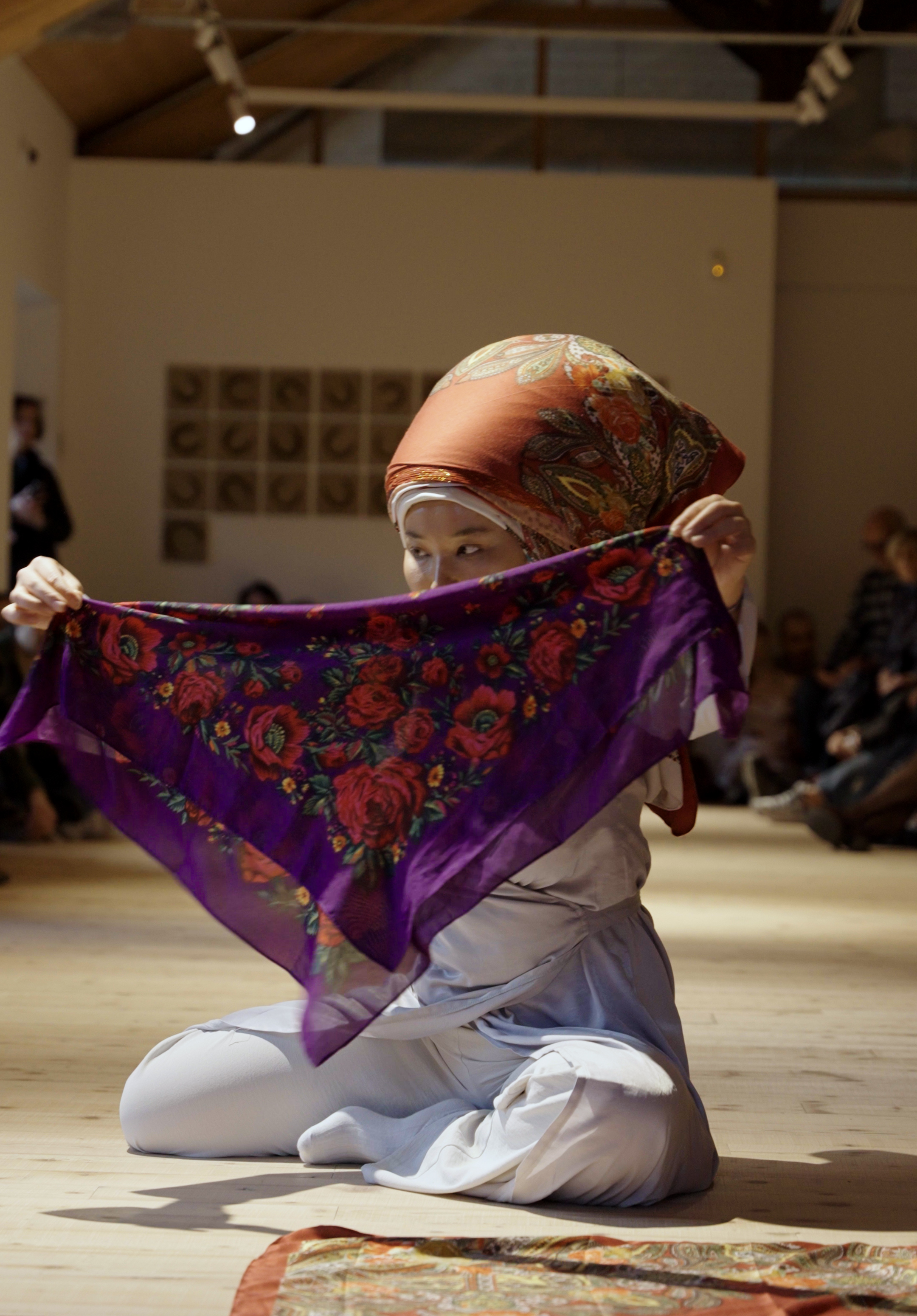
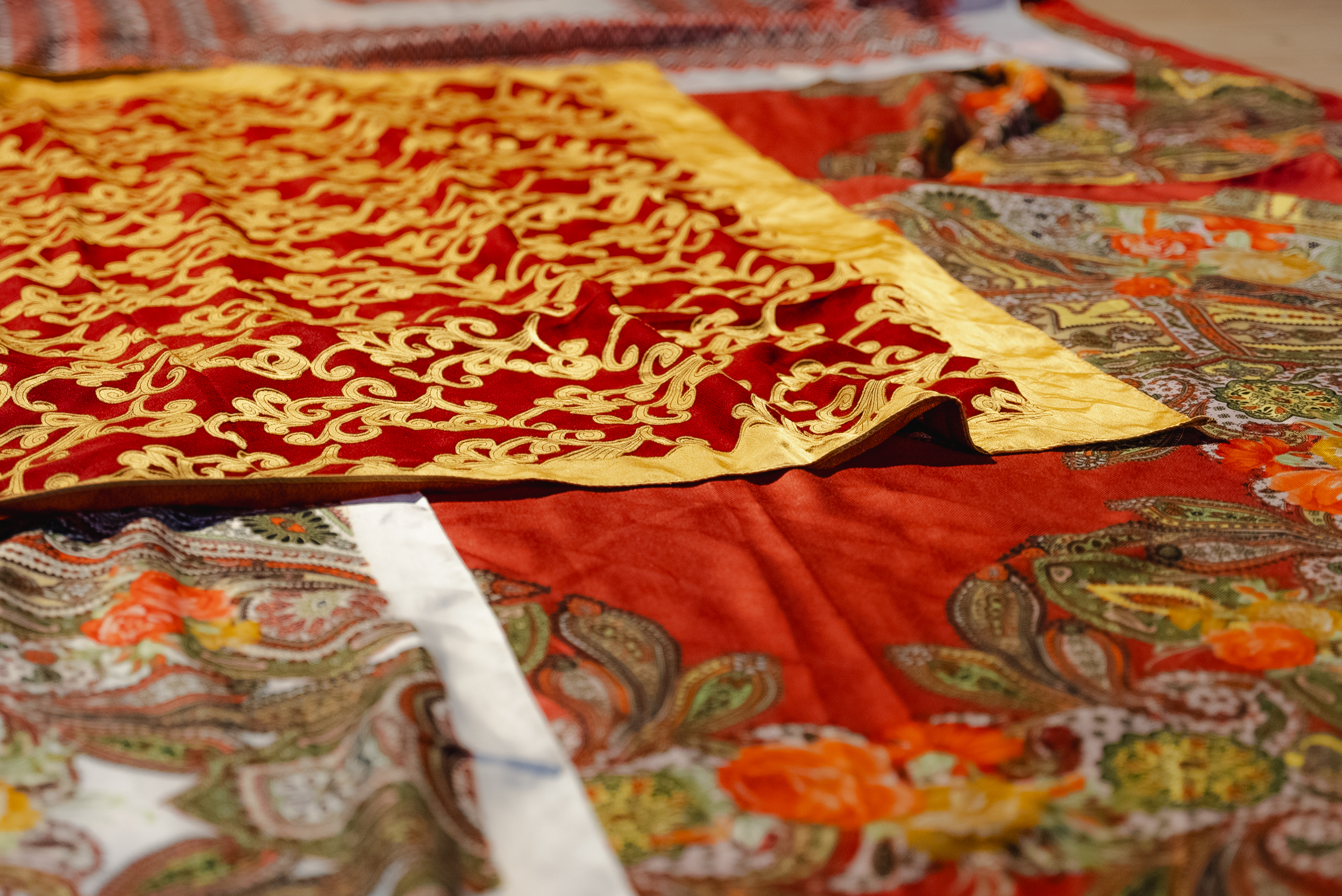
“I grew up seeing my mother in her headscarves. They are colorful with flowery patterns, red on white, orange, green, and sometimes purple. My mother takes them off her head without untying the ends, as she is always in a rush to do something—cook, prepare, unpack, nurture, plant, understand, sing a lullaby song, love, lament, fight, or take a nap. When I was 13, my mother migrated to Russia to work. The void her absence left felt unbearable in my young heart. Days later I found her headscarf, still tied at the ends, still holding her scent – a mix of maternal comfort and sweat of the day, still warm, still hers. It helped me to live through the toughest days in my life. This memory has
stayed with me, inspiring my artwork with the long-lasting emotions that a single object can evoke.”
Specifically for YOU ARE HERE. Central Asia Jazgul Madazimova has created a new piece reflecting on the idea of the departure of a loved one, nostalgia, and sadness related to it, but also how this separation leaves a possibility for a new encounter, a new beginning. The project unfolds in two
parts. Firstly, on the 2nd of April, the artist makes a durational performance reminiscing about her mother’s migration forced by the early independent Kyrgyzstan’s economic struggle through the scent of her hair left on a headscarf. Secondly, from April 10th to 13th, a site-specific installation
will welcome Fondazione Elpis’ guests, proposing a light closure full of hope for the collective Central Asian stories that the exhibition project presented.